Senegal KOICA Project Final Report

I am home in BC and alert after a few days. I was coming down with something- maybe malarial maybe not, so I took a curative dose of my malarials so that I wouldn t have to worry. I also had a bad chest cold and was given a course of antibiotics- for what its worth I feel fine.
Attached is the Senegal final report first draft sent out this morning. I included my daily log. This went out to KOICA, the Korea International Cooperation Agency,  with whom I was working for their reponse. The two engineers with who I worked are: Joohyun Kim, and Je-Min Lee.
Ron Rivera originally received the request on this project.  We had a number of concerns regarding this start up but we agreed to be generous in implementing the start up. -The nearest ceramic producers of any sort were also quite far away as well. Still the enthusiasm on the part of the  lead personnel convinced us to proceed.

Senegal KOICA Daily log by Burt Cohen


Wednesday September 17, 2008

Arrived in Dakar early on the morning and met with Mr. Joohyun Kim and Mr. Je-Min Lee.I rested and traveled to plastic manufacturer to examine possible receptacles for the finished filters. Heidi Kilsby accompanied me from Quesnel, BC. She has volunteered her time to assist with the project set up.

Thursday September 18th, 2008

In the morning we met with KOICA project coordinator at his office and Mr. Kim and I signed the official contract papers. Met Mr. Chou the Korean ambassador to Senegal introduced the project and share lunch together.

In the afternoon Mr. Joohyun Kim and Mr. Je- Min Lee and I traveled to a hardware store and a machine shop to search for project materials. We purchased a hydraulic jack and looked at parts for the propane burner system. We must still purchase plastic bags. Mr. Kim has arranged for steel to be purchased in Ourossogui for the steel plates, and Mr. Lee has arranged for transport of the brick from the brickyards outside of Dakar to Ourossogui.

While we are in Dakar the workers in Ourossogui are organizing the workshop, drying clay and preparing sawdust.

Still to organize-

  1. drill bit for spigots-
  2. plastic water pipe for flow testing
  3. Screens
  4. Plastic garbage bags
  5. Digital scale 0-5kg
  6. 0-20 kg balance scale
  7. Water pipefor flow tester
  8. propane tanks
  9. burners hose and regulators
  10. brushes

Friday, September 19, 2008

In the morning we Je-Min and Joohyun and I went to the Sandaga market place and purchased most of the materials in the list

Including 6 propane tanks to transport to Matam on Saturday. The truck will be pretty full because we are also taking food because some things are difficult to find in the area.

We were able to find plastic bags- although a little larger then we need. Scales- both digital and a spring were also found first thing. I am concerned about the supply of propane gas in the area- We may need to replenish gas to advance the temperature. To insure that this would not be a problem we chose to purchase 6 tanks. There still may be a problem with pressure drop if gas is withdrawn to quickly from the tanks during the firing. We may have to warm the tanks while we are firing.

Saturday- September 20th 2008

Traveled to Matam all night-

Sunday September 21st, 2008

Woke up after a couple of hours sleep and went to the new KOICA ceramic filter workshop tobriefly look at the workshop to meet with the workers see what had been prepared.

There is only about 5 X 25kg of clay crushed and screened. Evidently went the workers attempted to mill the clay it was too damp. There is some sawdust but none of it has been screened.

Monday September 22, 2008

Went from Matam to Ourossogui to with Je-Min and Joohyun Lee to prepare materials for the filters. In the morning we met with the mason and scheduled his work to begin the kiln. We planned the construction on the kiln roof. We assembled the filter press and aligned it.
I looked at the clay and made a shrinkage test then examined the clay’s plasticity and found it to be very plastic.

In the afternoon we traveled with the water district truck and dug and transported clay to the filter project HQ from the village of Oggo. Joohyun contracted for more clay to be transported by donkey cart from the village.The clay that we dug was put outside to dry. Clay that was already in the sun was sacked and transported to the neighboring mechanics shop to be run through the hammer mill. Arranged to make base plates for the filters.

Tuesday, September 23, 2008

Heidi Kilsby worked with the women potters screening sawdust. (Found a hedgehog underneath the sacks)

Worked with the neighboring mechanics shop. The mechanic welded legs on the ejection rod and made some filter base plates. The hammer mill screen was too small (.9mm). We had a screen with 1.5mm holes put on the hammer mill and set some of the water district workers to mill clay. I think that the screen may still be too small but the clay that is now dry seems to go through. The hammer mill is a fixed hammer design and not quite as noisy as

Flail types.

The first clay was transported by cart and put out to dry,

We prepared a first mix to test the press and realized that the hydraulic jack that had been purchased was too tall for the press. In the afternoon we attempted to find a smaller 20-ton jack but in the end it was easier to purchase a 6-ton and then exchange it with the larger 20-ton to complete each filter. We pressed a filter successfully. Our plan is to now prepare the first batch of filters in the series- this will be the 50/50 mix.

50/50 clay-sawdust by volume equates to- 85.6% clay 14.4% sawdust by weight. This 50/50 mix was given the mark- #1 in iron oxide

Single Filter sample is:

Clay 5992 gr85.6%

Sawdust 1008gr 14.4%

Total7000 gr100%

Water 2500 gr.

This mix was somewhat wet-

We evaluated the cost of the clay based on 160 sacks which will be delivered to the workshop at a cost of 70,000 cfa/$152 – Per sack= 438cfa/. 95cents

Wednesday September 24th, 2008

In the morning I conducted instruction in the mixing and pressing of filters with the team. The team included our two women potters from the village of Ogo.

I taught the two women first and with the help of Je-Min, Joohyun and Heidi we made sure that the women had the first chance to learn the process. Only then did we start the training with the men from the Department of hydrology who are in the filter team.

We formed a total of 15 Mix #1 Filters mostly from 2-6pm.

In the night a torrential thunderstorm came through the area and poured rain. This was unfortunate as most of the clay was outside drying at the time. We also lost clay that had been hammer milled and not covered.

Thursday September 25, 2008

Brought the computer into the workshop and met with the mason to begin on the kiln. I guided him through the construction process step by step until he felt confident.

Heidi Kilsby and Je-Min worked with the filter crew making the next mix- ( #2)

They were able to form the full 15 mixes over the course of the day.

Mix #2 Represents 20% more sawdust in comparison with mix #1

Mix#2-

Clay 5790 gr82.7%

Sawdust 1210gr 17.3%

Total7000 gr100%

Water 2500 gr.

In the afternoon we worked to develop a system to quickly prepare mortar for building the kiln using what clay we have as we don t want to use hammer milled dry clay as it is scarce. We prepared some mortar using a drill with an agitator but the clay was difficult to blend into a mortar. We worked with the mason and lined out the base of the kiln and then set the base bricks in place.

We will need to organize a way to burn waste oil and we will need some wood.

Friday September 26, 2008

This morning I was working with the mason on the kiln fireboxes. We had hydrology workshop workers working with the Je-Min and Heidi Kilsby forming filters. I went to make a brick chisel with the neighboring welder.

In forming one of the filters the male mold caved in at the base. When I looked at the casting it appeared to be turned out too thin but the mix was also quite dry.

We spent most of the rest of the day trying to figure out how to repair the mold and in the end we were introduced to a master welder machinist who just happened to have experience with aluminum. He also had aluminum welding rod. He re welded and then resurfaced the mold. We then cast two inches of cement in the bottom of the mold. Tomorrow we will have the mechanic cut a steel disc to insert in the base weld a 5 cm diameter pipe up right on top and them another larger plate at the top of the mold. This will be a kind of interior support for the mold, which we hope will prevent it from collapsing again.

Saturday September 27th 2008

We spent much of the day repairing the mold. We were able to cast cement in the male mold base and then Joohyun worked with the neighboring mechanic and welded up a brace and installed it inside the mold and we then bolted in to the press. We then cast 6 filters and compared them to the filters before the mold broke and found that they were the same. I bought a radio for the workers at the site.

At the same time I worked with the mason and he completed the base of the kiln. We received all the remaining brick from Dakar, so we are ready to work on the kiln and the press on Monday.

Update from Senegal – Burt Cohen

Greetings to all-
I am writing from Matam District eastern Senegal where it is very hot. I am here to set up the 31st ceramic water filter factory in collaboration with KOICA the Korea International Cooperation Agency. The twelve hour overland journey by sept-plus transport through the cool desert night air gave us great false hope that it might not be very hot where we were heading. The following morning we awoke to a 40 C day. We will begin to put materials in place that were brought from Canada in support of the factory.

Photo 1 – Day 2 on the job- Senegalese Koreans and Canadians collaborate and assemble a filter press to begin the new workshop at Orossogui Senegal.

Photo 2- KOICA Water engineers Je-Min Lee (left), Joohyun Kim(right), brought me to the desert of Matam Senegal-

More to come,

Burt

Final Report to Songhai Centre, Porto Novo, Benin West Africa September 20th, 2007

By Burt Cohen

Potters Without Borders originally met with students and Professor Streibig at Seattle University. As a result of this meeting I was asked to assist with the introduction of a Ceramic Water Filter facility at the Songhai Centre in Porto Novo Benin. I traveled to Benin and worked at Songhai centre from August 8th until September 12th, 2007. My participation was a result of a grant provided through the Rotary club of Spokane.

More then two months before arriving both Professor Streibig and myself communicated with Project Coordinator Thierry Andre and Songhai Centre Director Godfrey Nzamujo to identify materials and facilities needed for the production of Ceramic Water Filters. A week before my arrival, Engineering and nursing students and programme coordinators from Gonzaga University traveled to Benin.

The introduction of a new technology brings with it new challenges. The Songhai Centre in Benin has more then a twenty year history in Benin developing an integrated programme of agriculture production and community development in West Africa. This model is an excellent basis for the development of a ceramic water filter facility with an excellent potential for success. The centre views the introduction of this technology as needed and timely. Songhai is uniquely situated with a local market in Benin as well as a potential market in Nigeria of many millions less the 40 kilometers away. The integrated nature of the Songhai model influences their view of future CWF production.. In discussions with Thierry Andre, project coordinator and centre director Fr. Nzamujo it is hoped that CWF production can be introduced along with the development of other ceramic production including, brick, tile, ceramic planters and irrigation pots.

Upon my arrival in Benin, the students from Gonzaga and the Songhai Centre mechanics team had organized clay processing. The engineering students had developed an excellent portable filter press and had already formed 25 filters. This press- allowed us to form over 120 filters for the batch series test in order to evaluate the proper ratio of clay to sawdust.

Gonzaga University Portable Filter Press in Operation

gonzipressaction.jpg

Double scissor Filter Press

scissor-press.jpg

The last two weeks of my stay I worked with Mr Fiacre Aboua, Mr. Eusebe and Mr. Luciane of the mechanics workshop at Songhai centre to produce a new double scissor filter press. This press was tested during the last days of my stay to make sure that it was aligned. Some small adjustments needed to be made so that the filters would eject filters easily.
Forming Ceramic Water Filters
Based on evaluation of the flow testing results, I recommend that a ratio of 80% clay to 20% screened sawdust be used. For more information including formula see: benin-ceramic-water-filter-batch-series.doc

When the new filter factory begins to form new filters there will be some changes. It is important that all new filters be numbered in such a way that filters can be monitored. Each filter must receive a unique number as soon as it is formed .This numbering is stamped into the newly formed filter before it is ejected from the mold. The factory must keep daily reports to record all information about filter production. It is important that information about filter production indicate the number, the date of production, clay and sawdust proportions, weight of water, firing information and any unique information pertaining to production. A sample workshop log is provided as an example- benin-production-log.xls

Once filters are sold the sales information must also indicate the Filter number sold to a customer as well as the customer’s name and home address or village. This information is necessary to follow up studies that will monitor the filters’ effectiveness in the field.

Songhai Centre filter kiln under construction
songhaikiln.jpg

Kiln Construction and Operation
The kiln built during the period of the consultancy was meant to be one of two “Mani” type kilns. The first kiln has a double firebox design under the floor of the kiln. The kiln will fire more then 50 filters.

Kiln firings take 11 to 12 hours because of the warm up period needed to insure that carbon does not become trapped in the filter walls. A firing schedule has been included.
I recommend the use of draw trials to help with the evaluation of the firing progress. These small trials are made of the filter clay/sawdust mixture and removed at the end of the fire through a spy hole in the door od the kiln.
Pyrometric cones * are also used to make sure the fire has advanced correctly. Ordering information for these cones is included.

This kiln was made from red brick made by Jean Kokossou of Porto Novo. This brick was delivered in three lots. The first batch of brick was not fired hot enough to be durable. The next batches were fired higher and were stronger. The kiln was fired twice while I was in Benin. After the first firing the flat top cracked and separated from the wall. Before the second firing we rebuilt the roof as an arch.

Firing Recommendations
I would recommend that the next kiln be built with an arched roof as well and that the second kiln share the chimney with the first.

The first kiln made use of 100 fire brick to cover the fireboxes and form the floor of the kiln. The use of firebrick was important as waste oil is a stress on the red brick used in the fireboxes. If possible firebrick should be used in the base of the second kiln. If it is not possible to buy firebrick for a second kiln, then I would suggest that outer walls of the next kiln be made twice as thick. If firebrick is found, then the fireboxes and floor of the kiln can be made from this brick and the chamber can be red brick.

The most important problem with firing filters at the Songhai Centre is the fuel used to fire the filters. Although we used waste (black) oil to finish both filter firings, waste oil is not a recommended fuel in this kiln because of the poor quality of the brick. The brick in the fireboxes will darken, vitrify and deteriorate with the higher temperatures from long use of waste oil.

Wood used in the firings must be purchased and stored at least three months in advance and it must be split in small cross sections. Unless the wood is completely dry, the firing will stall in temperature beyond 700 C. The difference between using wood in cooking fires and using in a kiln is that poorly dried wood can be used without problem in a cooking fire- in a kiln the same wood will prevent the advance of the firing because the energy of the burning wood is consumed in boiling off the water in the fireboxes. If the wood is completely dry waste oil will not be needed to bring the temperature to 900 C, or very little will be needed.

Other fuels may be used in the kiln-along with the wood such as palm oil kernels (rancid), and agricultural waste such as ground nut shells.

Target filter firing schedule is reproduced in the document: benin-filter-target-firing-schedule.xls
Firing Schedules from the first two firing are shown in the two excel documents: benin-filter-firing-september-6th-2007.xls, benin-filter-firing-sept-10-2007.xls

Follow-up:It would be very useful if the workers responsible for filter firing and production have the opportunity to visit the Ghana filter factory- to participate in firing and production exercises.
Requirements in order to produce bricks for CWF production will be forwarded to the Songhai Centre.

New Filter Workshop
The new filter workshop is developing around the filter kiln. A roof has been built over the new production area. This space is already separated into work areas with cement block walls. Two smaller rooms with doors will provide secure storage for the working solution of colloidal silver, scales, pyrometers and production supplies.

Areas are needed for:

1.dry storage of wood, clay and sawdust.
2.hammer milling of clay
3.screening of clay and sawdust
4.The masons have already provided a soaking tank for flow testing of filters
5.wet mixing of clay/sawdust
6.filter press forming
7.drying racks for finished filters
8.storage of plastic bucket receptacles
9.kiln
10.storage of finished filters
—————

Colloidal Silver ordering information:
Ivana Ascaso
Sales Assistant/ Managing Director
Laboratorios Argenol S.L.
Autovía de Logroño Km 7,400
50011 Zaragoza, Spain
Tel: + 34 976 336266
Fax: + 34 976 533659
www.laboratorios-argenol.com

*Pyrometeric Cones purchase information: 010, 012, and 014
Axner and Company of Florida
http://www.axner.com/axner/tools/cones.

Pyrometers and Thermocouples: http://www.wardburner.com/home.html

Potters Without Borders –http://www.potterswithoutborders.com/
Potters For Peace-http://www.pottersforpeace.org/

songhaigroup.jpg

Burt Cohen
Director Potters Without Borders
burtcohen@potterswithoutborders.com
PO Box 1006
Enderby, BC V0E1V0
Canada
250-838-9799
This Document is also available as a PDF: songhai-pwb-final-report.pdf

Supporting files: songhai-report-documents.zip

Sana'a Test Firing Curve 7:42am – 7:40pm

Cones 010 mini-919 C.
Standard Cones
#013-837-859
#012-858-880
#011-873-892C
#09-917-928C

Firing start time 7:42AM

Firing end time 7:40 PM

TIME LOWER DOOR TOP DOOR CHIMNEY NOTES
0
0.5 60 85 122 4 Burners
1 69 93 128 1.3hr-6 Burners
1.5 93 118 156 Damper@ 15cm
2.08 111 133 170
3.1 173 195 248
3.58 187 209 260
3.95 208 230 307
4.53 293 295 388
5 345 317 415
5.28 347 401 448
5.45 417 401 448
5.45 417 401 452
5.75 438 480 465
6.68 414 518 481
6.88 504 536 501
7 509 537 509
7.33 539 575 530
7.53 554 588 543
8 610 646 602
8.35 650 684 639
8.66 675 708 684
9 712 744 717
9.2 729 763 738
9.58 750 729 755
9.75 784 813 784
9.96 748 830 804
10.16 832 862 836
10.2 844 874 845
10.26 848 877 855
10.45 865 891 867
10.5 871 897 874
10.58 874 899 878
10.66 877 901 881
10.86 880 903 885
11 883 906 888
11.1 885 906 890
11.43 880 902 886

Photos From Yemen GTZ- Integrated Water Resources Management (IWRM) Project

I just received these photos from Burt…

ali-salman-and-burt-cohen-mixing-test-batches-for-cwf.JPG ali-salman-and-burt-cohen-mixing-test-batches-for-cwf

hayel-said-saleh-making-a-tanoor-overn.JPG hayel-said-saleh-making-a-tanoor-overn

front-of-press.JPG front-of-press

back-of-double-scissor-press.JPGback-of-double-scissor-press

new-filters.JPGnew-filters

dsc01956.JPGFilters in the kiln

dsc01995.JPGFlow Testing Filters

ali-applying-cs.JPGali-applying-cs

Final Report and Recommendations for development of the Silver filter workshop – Yemen

GTZ-Integrated Water Resources Management, (IWRM) is involved in projects concerned with water management in Yemen. This project’s involvement with traditional Yemeni potters began to encourage the production of irrigation pots as a tool to reduce the amount of water used in farming in water poor Yemen. At the same time there was interest in the introduction of Ceramic Water Filters. (CWF) 500 water filters had been imported into the southern Shabwa Province with very good acceptance amongst the recipients. (These 500 filters were produced at workshops originally set up by Potters For Peace for IDE Cambodia.) It was felt that a combination of CWF, irrigation pots, with traditional and non-traditional pottery could diversify and strengthen the income of a potter family of potters willing to enter into a relationship with GTZ was identified before my arrival.

The Salman pottery workshop in Sana’a Yemen is located in a rural area of the city. This workshop entered into a relationship with GTZ earlier this year. Mr. Richard Boni working for GTZ has coordinated this relationship along with Mr. Michael Klingler of GTZ Integrated Water Resources Management. The Salman family lives at the workshop and includes Ali Saleh Said Salman, Ali’s father-Saleh Said Salman, Ali’s brother- Muntesar Saleh Said Salman, cousin Tewfik Ali Yahya Azizzi, Selam Sale Said Salman Ali’s mother- Fatimah Ali Mahdi and Ali’s wife.

Some months before my arrival, a catenary arched downdraft kiln approximately 120 cubic feet in size (4 cubic meters) was designed and built for the workshop by Bernd Pfannkuchen through assistance by GTZ-(IWRM Yemen . The kiln is propane fired, which was considered the fuel of choice, because of the high cost of wood and charcoal. The size of the kiln reflects the need to accommodate tanoors, traditional Arab ovens, which are a substantial part of the production of the workshop. These ovens are made in a number of different sizes, the largest of which can be almost one meter in height and 50cm in diameter. When I worked in the pottery, the potters were in the midst of filling an order of tanoors as a partial repayment of loans advanced for the construction of the kiln and the purchase of the land.

The construction of the pottery workshop and compound is cement blocks with corrugated sheet metal roofing. When I arrived in early April the kiln had only been fired a few times.

The main production at the workshop is traditional Yemeni unglazed earthenware pots. The clay is mostly unrefined and prepared quickly by wetting the clay and foot wedging on the floor of the workshop. The pottery produces ware by coil and smear method, forming on plywood batts, which are set on platforms, usually old car tire rims. The potters form by walking around the developing forms (usually backward) while manipulating the clay in a series of deft processes akin to using a potter’s wheel: coiling and smearing until the basic form is begun, then paddling with a wooden form, drawing and evening the walls of the pot- next the form is thinned and drawn up and finally smoothing with a wet cloth. These potters are masters of this method of forming. They work as a family unit, father and sons sharing in all of the work. .

The production of ceramic water filters required changes throughout the workshop beginning from the clay preparation. Traditionally, clay is trucked in from the mine and deposited in an area adjacent to the workshop and left uncovered and open to the elements.

Normally clay for CWF must be dried and screened and put in sacks or otherwise covered to reduce variation caused by moisture. In Sana’a the dryness of the desert doesn’t seem to be much of a problem. Even on days when it rained, most of the moisture in the clay had evaporated within a couple of hours. Despite this, I feel it is important that the clay be carefully screened and sacked. Clay for traditional ware is not screened. The potters understand that the filters require screened clay but they may not yet see that this also affects the characteristics of the finished ware. Clay that is finer due to screening will form pots which are denser and therefore have less thermal shock qualities. For most pieces this doesn’t cause a problem but it may for tanoors. Not being familiar with the day to day use of a tanoor oven used in a traditional Yemeni kitchen, I do not know to what extent this will be a problem.

Before my arrival in Yemen instructions were sent to the pottery to prepare 50 sacks of screened clay and a large quantity of dried sawdust. A large cement block soaking tank was made for the flow testing of filters and colloidal silver was purchased for the treatment of fired filters. A log of activities was prepared as work progressed.

Upon my arrival in Yemen, Richard Boni and I spent more than a week modifying an existing mechanical press for forming ceramic filters from clay. After the press was prepared, the moulds were attached, and it was delivered to the pottery. The inability to find a clay mixer of an appropriate design meant that it was necessary to prepare the clay/sawdust mix by hand using plastic mixing buckets.

The screened dry clay and sawdust were first weighed using a gram scale and then dry mixed. The blended dry materials were then wet mixed, lightly wedged, and weighed again into 9kg batches.

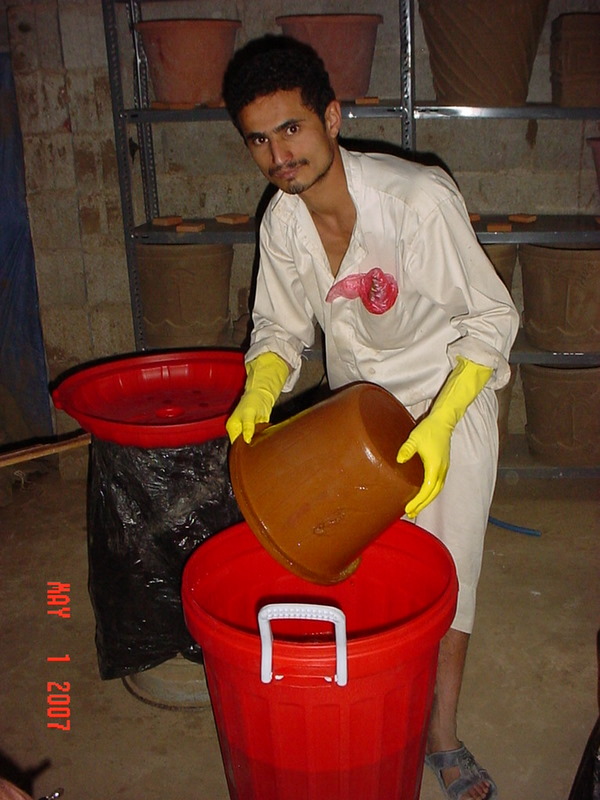
Each of the filters was formed using the new press. The female mould was lined with a plastic bag and the male mould was also covered with a bag. These plastic bags act as separators and allow the filters to be released cleanly from the moulds. The 9 kg. Charge of the clay/sawdust mix was pressed into the bottom of the female mould and it was raised into position. A hydraulic jack was set into position on the press and the female mould was pressed up with20 tons of pressure. The top of the press frame is hammered with a rubber mallet to release the filters. Once the pressure was released, the female mould was lowered and the plastic liner was removed from the female mould. Next the inside of the now accessible new filter was fettled to smooth and correct any imperfections. The filter in the female mould is now raised again on the press and an ejector rod is placed into position and the new filter is ejected from the female mould by lowering it on the press. Finally the new filter is removed from the press. Each filter was carefully dried by loosening the remaining plastic bag from against the outside of the newly formed filter. The filters were carefully monitored to prevent them from drying too quickly in the arid desert air by keeping them loosely covered with plastic and then after uncovering them, by turning them upside down if the lips dry too quickly. Drying took 4 to 5 days.

Once dry, the filters were stacked in the kiln and fired to a target temperature of 900C. Information concerning firing can be found in the two excel documents-‘Sana’a Test Firing Curve’ and ‘April 28th 07 filter firing- Sana a’

Six different clay/sawdust ratios of filters were attempted. The formulations were dried and fired in the kiln. The results of this series of filter tests showed that the following mix produced the best flow rate results:

Mix #1

Formula Batch Wt.

Sana’a Clay- 95% 8550

Sawdust 5% 450

Total 100% 9000gr.

2.4liters of water

See word document – ‘Yemen Ceramic Water Filter Flow Test Results’

The average rate of water flow for this proportion was 2.33liters per hour. It must be remembered however that this flow rate was achieved at a temperature of between 915-923 degrees Celsius. If the temperature is lowered substantially from this, the proportion of sawdust to clay will need to be adjusted. I think that a target of 900 C. probably will not require adjustment however flow testing will determine this.

One Hour Flow test-After forming and firing to a temperature of between 912-923C most filters were soaked in water in the cement tank for more than twenty four hours. The filters were then filled with water and allowed to stand for one hour. The amount of water filtered was measured using a PVC tee shaped gauge. (See photos) The cement soaking tank needs to be kept full of water for a period of time and then rinsed out to clean out the fine silt which will become trapped in the pores of the new filters.

I would recommend that another batch series of filters be formed and tested. This will further refine the flow rates. A minimum of ten filters of Test A, B and C below should be fired and flow tested. Once this test is finalized and the final clay/sawdust proportion is decided upon, the workshop can translate the weight proportions to volume measurements with appropriate sized containers. This should considerably speed up the forming process.

Test A Formula Batch Wt.

Sana’a Clay- 96% 8640

Sawdust 4% 360

Total 100% 9000gr.

2.4liters of water

Test B Formula Batch Wt.

Sana’a Clay- 96.5 8685

Sawdust 3.5% 315

Total 100% 9000gr.

2.4liters of water

Test C Formula Batch Wt.

Sana’a Clay- 97% 8730

Sawdust 3% 270

Total 100% 9000gr.

2.4liters of water

Colloidal Silver Recommendations and Precautions

We conducted a training session on the application of Colloidal Silver (CS) Out of this session I have made a number of recommendations for the workshop

  • A room with shelves should be built for the storage of CS and dipping solution and utensils
  • Containers and Mixing implements should not be used for other purposes
  • CS should be kept in it s original container
  • When not in use CS dipping solution should be kept in a covered container
  • Mixing and application of CS must be done with protective gloves to limit skin contact
  • Clean up of containers and implements will result in contaminated cloth and water, this material should be disposed of in the latrine
  • Two persons should be designated for CS preparation and application
  • The next time that CS is applied to filters the methodology should be reviewed again especially the need to mix the solution properly before dipping
  • CS in the concentrated form used for application to filters can accumulate in the body , care must be taken to prevent contamination of the workshop environment, ground etc. These precautions should be reviewed the next time CS is applied to filters. These precautions should be provided in Arabic

Safety recommendations for the handling of propane

Propane is a not new in Yemen being produced there, but as a fuel for artisan potters it is. The sophistication of the firing system at the Salman workshop is well thought out. Of particular importance is the forethought of including small safety shut off valves on each burner. A problem of the gas system is that the removal and filling of the 16 gas cylinders requires careful monitoring to be certain that there are no leaks at the cylinder valve as well as at the hose clamps.

In a situation like this, where a number of small gas cylinders are teamed together to a manifold, the cylinders cannot be completely discharged because of the speed of gas withdrawal during the firing. The potters are understandably unhappy by the amount of gas remaining that they lose due to this. They have made attempts to withdraw this remaining gas from one cylinder to another. This is not a safe practice and they must be cautioned about this.

For a number of months before my arrival in Yemen attempts were made to locate both a hammer mill for crushing clay and a mixer for preparing the wet clay batches without success. An appropriate mixer design was shared with Nasser machine shop for quotation.

  • An appropriate clay mixer design may be found in the Adobe Acrobat 7.0 Document – clay mixer
  • Filters should be individually numbered tracking number while they are still in the mould This tracking number allows the workshop to better understand the success of the production process and it also allows for the systematic monitoring of the filters in the community. It is essential that the workshop record the sale of filters so that they may be followed. Filters formed for the test series were numbered by using iron oxide. A rubber stamp for numbering filters has been ordered for the workshop.
  • A health monitoring agency must still be identified for the field assessment of filters as soon as filters are ready to be sold. Potters Without Borders requests that GTZ inform us when this relationship is established so that we may assist with questions that may arise from the monitoring process
  • Presence/absence tests (P/A test) from Hach Company of Colorado were identified for the monitoring of filter’s ability to remove bacteria. The use of P/A tests were discussed and Richard Boni conducted the first test of water from a contaminated source to demonstrate the filters ability to eliminate bacteria

Conclusions after set up of the filter workshopThe conclusion of the ceramic water filter training now means that the Salman pottery workshop has the ability to form filters from locally available raw clays. The ability of the workshop to take this new capacity and deliver properly functioning ceramic water filters into the community will require careful follow.The Salman workshop will need support in order to be able to consistently reproduce filters with correct rates of flow. The Salman`s have a strong understanding of ceramic process. As an example within two weeks of first using the new ceramic filter press, the workshop adapted the forming process to simplify and speed up the forming of irrigation pots. Although I discussed the need for consistency in processing of raw materials and in the forming process I feel the workshop will need assistance to maintain this discipline and to make sure that all those being trained in the key processes of, material preparation, forming, firing, flow testing, and colloidal silver application are well prepared as well. Richard Boni has been instrumental in the members of the Salman workshop understanding and accepting these new technologies. His continued involvement in monitoring and assisting the workshop with scientific method is invaluable to the workshops success.A number of extensive studies on similar new ceramic water filter workshops indicate that the production of silver filters in Yemen will result positively impact the health of the end users. Water poor Yemen currently does not have the ability to service outlying communities with piped potable water. CWF is a credible technology that will deliver safe water to at risk communities with little waste. Potable water is produced directly in the homes of users without the need for separate extensive piped systems.

After the successful firing of filters, Richard and I went into the commercial areas of Sana’a and were able to find a plastic receptacle which fit the filters. Since then a second filter has been identified. The Salman workshop is also developing a receptacle made out of clay similar in design to traditional Yemeni water containers. Developing a number of receptacles at various prices will encourage the acceptance of CWF. GTZ has arranged for the translation of the cleaning protocols for the filters. Other CWF workshops have contracted plastic receptacles with both instructions and logo imprinted directly in the body of the plastic in so doing they create professional approach to the marketplace and speed up acceptance.

  • Production Forms for water filters-to follow
  • A computer assisted design(CAD) for a mechanical screen to prepare sawdust will follow

Download Document 49kb: burt-cohen-potters-without-borders-yemen-final-report-a.doc

GTZ Yemen Ceramic Water Filter Flow Test Results

GTZ Yemen Ceramic Water Filter Flow Test Results

Summary

6 -#1 Mix Filters 2.33 liters/hour average

10 – #2 Mix filters all more then 3.5 liters per hour

9- # 3 Mix Filters- All more then 3.5 liters/hour

1-#4 Mix Filter- More then 3.5 liters per hour

No # 5 Mix filters survived the forming process –due to fragility

4 -#6filters- All more then 3.5 liters/hour

Total Filters Flow Tested-30

Filters formed- 48

One Hour Flow test-After forming and firing to a temperature of between 912-923C most filters were soaked in water for more than twenty four hours. The filters were then filled with water and allowed to stand for one hour. The amount of water filtered was measured using a pvc tee shaped gauge which was set on the filters. (See photos)

Mix #1

Formula Batch Wt.

Sana’a Clay- 95% 8550

Sawdust 5% 450

100% 9000gr.

Of 6- Mix #1 Filters

2.5liters

2.5 liters

2.5 liters

2 liters

2 liters

2.5 liters

Flow Test-2.33 liters/hour average

Mix 2– 5% More clay then 50/50 Proportion

Formula Batch Wt.

Sana’a Clay- 90% 8100

Sawdust 10 900

100% 9000gr.

Flow test

Of 10- Mix#2 filters- All filters were more then 3.5 liters per hour

Mix 3– 50/50 Proportion by Volume

Formula Batch Wt.

Sana’a Clay- 85.6% 8127

Sawdust 14.4 1372

100% 9499gr.

3.5 liters water (estimated)

Flow test–

Of 9- Mix #3 Filters- All filters were more than 3.5 liters/hour

Mix 4 – 5% Less clay then 50/50 Proportion

Formula Batch Wt.

Sana’a Clay- 80% 7136

Sawdust 20% 1784

  1. 8920

Flow Test

Only 1- Mix# 4 filter emerged from the mold intact, because of fragility-( One filter broke during flow testing) This filter was more than 3.5 liter/hour

Mix #5

Formula Batch Wt.

Sana’a Clay- 75% 6750

Sawdust 25% 2250

100% 9000gr

Flow Test-

No Mix#5 filters survived the forming process

Mix #6

Formula Batch Wt.

Sana’a Clay- 92.5% 8325

Sawdust 7.5% 675

100% 9000gr.

Flow test

Of 4 –Mix# 6 filters-all were more than 3.5 liters/hour

Download full document 34kb: yemen-ceramic-water-filter-flow-test-results.docyemen-ceramic-water-filter-flow-test-results.doc

April 28th 2007 filter firing Yemen GTZ

Time Description Door Bottom Door Top Chimney Side


Kiln On 4 corner burners


:30
60 93 122


1:00 Damper at 10 cm 69 93 128


1:22 6 burners (2 more near to the door)


1:30 Damper @ 15 cm 93 118 156


2:05
111 133 170


3:06
173 195 248


3:35 Smoke beginning to generate from filters 187 209 265


3:40 Heavy smoke


3:57
208 230 307


4:23 smoke reduced 228 245 337


4:26 8 Burners Damper@ 24 cm


4:38 Damper @ 27 cm 293 295 388


5:00 10 Burners 345 317 415


5:17
347 401 448


5:22 12 Burners (2 on low)


5:27
417 401 457


5:45
438 480 465


6:41 All burners on low 474 518 481


6:53
504 536 501


7:00 Increase two burners either side of the door 509 537 509


7:20
539 575 530


7:32 Increase ten more burners 554 588 543


8:00 Increase ten burners again slightly more 610 646 602


8:22 Damper @ 24 cm 650 684 639


8:40 Increase 8 burners on chimney side to full on 675 708 684


9:00 Increase 4 burners on door side to full 712 744 717


9:12 All burners on full 729 763 738


9:35
750 779 755


9:45 Increased pressure on gas manifold by kiln 784 813 784


9:58 Switched propane cylinder bank to +pressure 798 830 804


10:05 Cone 013 down 012 bending


10:10 Cone011 Bending 832 862 836


10:12 Cone 011 @ 3 o clock


10:14 Cone 011 down 844 874 845


10:16 Open damper to 22 cm 848 877


10:27
865 891 867


10:30
871 897 874


10:35 Begin Soaking period 874 899 878


10:40 All Cones except 09 down -reduce pressure 877 901 881


10:52 increase pressure slightly to maintain pressure 880 903 885


upper Cone 09 @ 3 o clock


11:00 ` 883 906 888


11:06
885 906 890


11:26
880 902 886


11:39 Kiln Off


Notes on the Sana’a, Yemen filter firing April 28th, 2007
The firing of the ceramic filters followed a firing of tanoor ovens by two days insuring that the kiln was well dried.
In firing the filters I was particularly concerned that all of the sawdust would be completely burned out so that trapped carbon would not cause a problem with the filters. This is necessary so that the finished filter be as strong as possible and so that flow rates not be effected by carbon in the filter body. Care must be taken in the stacking of the filters in the kiln to separate the filters using spacers so that heat can infiltrate throughout the setting. Filters should not stacked bottom to bottom without spacers as well. The filters staked on the floor of the kiln should be stacked on top of brick to elevate them. Another thermocouple was installed near the floor of the door to monitor the difference in temperature between the floor and the upper part of the kiln. It is recommended that monitoring of the temperature advance is done with a combination pyrometer, Orton temperature cones and draw trials.

A warm up period with a target temperature of 300 Celsius in the first 4 hours proved adequate to insure both moisture and carbon was not trapped.
After the warm up, an advance of 100 C per hour was desired up until a target temperature of 900 C. In practice we took longer to advance in temperature due to the amount of smoke which was generated by the burning out of the sawdust . At target temperature the firing was soaked for one hour. I had intended to soak for a longer period as per advice by other filter technicians, but after discussion with Bernd Pfannkuchen the kiln designer, and through evaluation of the draw trials* at the target temperature I decided that one hour soaking was adequate. An examination of the finished filters showed that there was no trapped carbon. The original recommendation of a longer soaking period is based on the use of the Mani kiln which is using solid fuels (wood) whereas the Sana’a catenary kiln fires with Propane under oxidizing conditions. Having the designer of the kiln to assist in the filter firing was a real advantage. Bernd gave advice and the kiln design proved very versatile. It is noteworthy that the Orton cones and the pyrometers showed less then one cone differential in temperature throughout the kiln.
*The draw trials were made from the same mix of clay and sawdust and formed into rings. These trials were positioned in the kiln on two levels near the floor and withdrawn through the ports in the door. These rings were then examined for residual carbon as well as for strength.

Pororsity Tests

Pororsity Tests*-150 to 200 gram Sections of fired filters were cut out of the lip, weighed, soaked for 24 hours and then re-weighed to evaluate.

Ceramic Water Filter Test Batch No. 1
Thursday January 18, 2007
Pororsity Test*- 38.8%
******

Ceramic Water Filter Test Batch No. 2
Saturday January 20th, 2007
Pororsity Test*- 32.2%
Mix Proportion represents 10% less sawdust than mix No. 1

******

Ceramic Water Filter Test Batch No. 3
January 22, 2007
Pororsity Test*- 34.5%
Mix Proportion represents 20% less sawdust than mix No. 1

******

Ceramic Water Filter Test Batch No. 4
January 24, 2007
Pororsity Test*- 45.6%
Mix Proportion represents 10% more sawdust than mix No. 1
******
Ceramic Water Filter Test Batch No. 5
January 25, 2007
Pororsity Test*- 49.7%
Mix Proportion represents 20% more sawdust than mix No. 1

Technorati Tags : ,