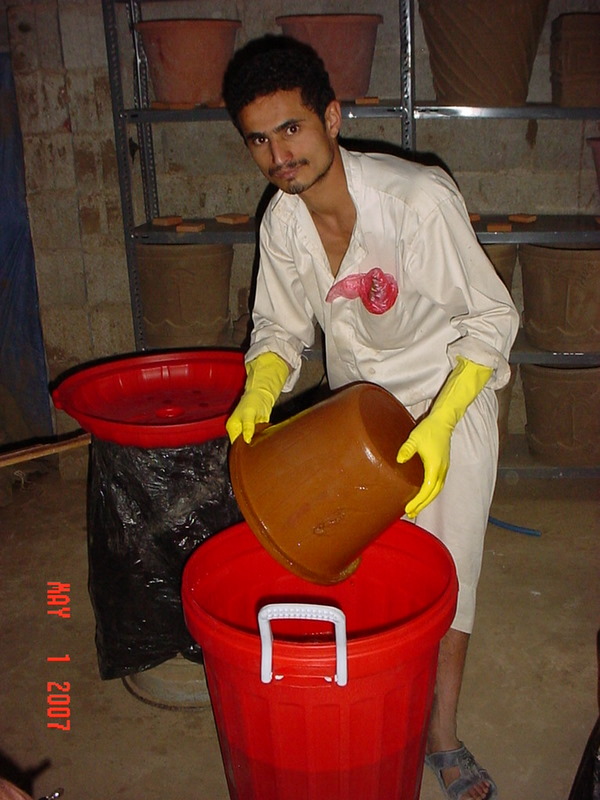
GTZ-Integrated Water Resources Management, (IWRM) is involved in projects concerned with water management in Yemen. This project’s involvement with traditional Yemeni potters began to encourage the production of irrigation pots as a tool to reduce the amount of water used in farming in water poor Yemen. At the same time there was interest in the introduction of Ceramic Water Filters. (CWF) 500 water filters had been imported into the southern Shabwa Province with very good acceptance amongst the recipients. (These 500 filters were produced at workshops originally set up by Potters For Peace for IDE Cambodia.) It was felt that a combination of CWF, irrigation pots, with traditional and non-traditional pottery could diversify and strengthen the income of a potter family of potters willing to enter into a relationship with GTZ was identified before my arrival.
The Salman pottery workshop in Sana’a Yemen is located in a rural area of the city. This workshop entered into a relationship with GTZ earlier this year. Mr. Richard Boni working for GTZ has coordinated this relationship along with Mr. Michael Klingler of GTZ Integrated Water Resources Management. The Salman family lives at the workshop and includes Ali Saleh Said Salman, Ali’s father-Saleh Said Salman, Ali’s brother- Muntesar Saleh Said Salman, cousin Tewfik Ali Yahya Azizzi, Selam Sale Said Salman Ali’s mother- Fatimah Ali Mahdi and Ali’s wife.
Some months before my arrival, a catenary arched downdraft kiln approximately 120 cubic feet in size (4 cubic meters) was designed and built for the workshop by Bernd Pfannkuchen through assistance by GTZ-(IWRM Yemen . The kiln is propane fired, which was considered the fuel of choice, because of the high cost of wood and charcoal. The size of the kiln reflects the need to accommodate tanoors, traditional Arab ovens, which are a substantial part of the production of the workshop. These ovens are made in a number of different sizes, the largest of which can be almost one meter in height and 50cm in diameter. When I worked in the pottery, the potters were in the midst of filling an order of tanoors as a partial repayment of loans advanced for the construction of the kiln and the purchase of the land.
The construction of the pottery workshop and compound is cement blocks with corrugated sheet metal roofing. When I arrived in early April the kiln had only been fired a few times.
The main production at the workshop is traditional Yemeni unglazed earthenware pots. The clay is mostly unrefined and prepared quickly by wetting the clay and foot wedging on the floor of the workshop. The pottery produces ware by coil and smear method, forming on plywood batts, which are set on platforms, usually old car tire rims. The potters form by walking around the developing forms (usually backward) while manipulating the clay in a series of deft processes akin to using a potter’s wheel: coiling and smearing until the basic form is begun, then paddling with a wooden form, drawing and evening the walls of the pot- next the form is thinned and drawn up and finally smoothing with a wet cloth. These potters are masters of this method of forming. They work as a family unit, father and sons sharing in all of the work. .
The production of ceramic water filters required changes throughout the workshop beginning from the clay preparation. Traditionally, clay is trucked in from the mine and deposited in an area adjacent to the workshop and left uncovered and open to the elements.
Normally clay for CWF must be dried and screened and put in sacks or otherwise covered to reduce variation caused by moisture. In Sana’a the dryness of the desert doesn’t seem to be much of a problem. Even on days when it rained, most of the moisture in the clay had evaporated within a couple of hours. Despite this, I feel it is important that the clay be carefully screened and sacked. Clay for traditional ware is not screened. The potters understand that the filters require screened clay but they may not yet see that this also affects the characteristics of the finished ware. Clay that is finer due to screening will form pots which are denser and therefore have less thermal shock qualities. For most pieces this doesn’t cause a problem but it may for tanoors. Not being familiar with the day to day use of a tanoor oven used in a traditional Yemeni kitchen, I do not know to what extent this will be a problem.
Before my arrival in Yemen instructions were sent to the pottery to prepare 50 sacks of screened clay and a large quantity of dried sawdust. A large cement block soaking tank was made for the flow testing of filters and colloidal silver was purchased for the treatment of fired filters. A log of activities was prepared as work progressed.
Upon my arrival in Yemen, Richard Boni and I spent more than a week modifying an existing mechanical press for forming ceramic filters from clay. After the press was prepared, the moulds were attached, and it was delivered to the pottery. The inability to find a clay mixer of an appropriate design meant that it was necessary to prepare the clay/sawdust mix by hand using plastic mixing buckets.
The screened dry clay and sawdust were first weighed using a gram scale and then dry mixed. The blended dry materials were then wet mixed, lightly wedged, and weighed again into 9kg batches.
Each of the filters was formed using the new press. The female mould was lined with a plastic bag and the male mould was also covered with a bag. These plastic bags act as separators and allow the filters to be released cleanly from the moulds. The 9 kg. Charge of the clay/sawdust mix was pressed into the bottom of the female mould and it was raised into position. A hydraulic jack was set into position on the press and the female mould was pressed up with20 tons of pressure. The top of the press frame is hammered with a rubber mallet to release the filters. Once the pressure was released, the female mould was lowered and the plastic liner was removed from the female mould. Next the inside of the now accessible new filter was fettled to smooth and correct any imperfections. The filter in the female mould is now raised again on the press and an ejector rod is placed into position and the new filter is ejected from the female mould by lowering it on the press. Finally the new filter is removed from the press. Each filter was carefully dried by loosening the remaining plastic bag from against the outside of the newly formed filter. The filters were carefully monitored to prevent them from drying too quickly in the arid desert air by keeping them loosely covered with plastic and then after uncovering them, by turning them upside down if the lips dry too quickly. Drying took 4 to 5 days.
Once dry, the filters were stacked in the kiln and fired to a target temperature of 900C. Information concerning firing can be found in the two excel documents-‘Sana’a Test Firing Curve’ and ‘April 28th 07 filter firing- Sana a’
Six different clay/sawdust ratios of filters were attempted. The formulations were dried and fired in the kiln. The results of this series of filter tests showed that the following mix produced the best flow rate results:
Mix #1
Formula Batch Wt.
Sana’a Clay- 95% 8550
Sawdust 5% 450
Total 100% 9000gr.
2.4liters of water
See word document – ‘Yemen Ceramic Water Filter Flow Test Results’
The average rate of water flow for this proportion was 2.33liters per hour. It must be remembered however that this flow rate was achieved at a temperature of between 915-923 degrees Celsius. If the temperature is lowered substantially from this, the proportion of sawdust to clay will need to be adjusted. I think that a target of 900 C. probably will not require adjustment however flow testing will determine this.
One Hour Flow test-After forming and firing to a temperature of between 912-923C most filters were soaked in water in the cement tank for more than twenty four hours. The filters were then filled with water and allowed to stand for one hour. The amount of water filtered was measured using a PVC tee shaped gauge. (See photos) The cement soaking tank needs to be kept full of water for a period of time and then rinsed out to clean out the fine silt which will become trapped in the pores of the new filters.
I would recommend that another batch series of filters be formed and tested. This will further refine the flow rates. A minimum of ten filters of Test A, B and C below should be fired and flow tested. Once this test is finalized and the final clay/sawdust proportion is decided upon, the workshop can translate the weight proportions to volume measurements with appropriate sized containers. This should considerably speed up the forming process.
Test A Formula Batch Wt.
Sana’a Clay- 96% 8640
Sawdust 4% 360
Total 100% 9000gr.
2.4liters of water
Test B Formula Batch Wt.
Sana’a Clay- 96.5 8685
Sawdust 3.5% 315
Total 100% 9000gr.
2.4liters of water
Test C Formula Batch Wt.
Sana’a Clay- 97% 8730
Sawdust 3% 270
Total 100% 9000gr.
2.4liters of water
Colloidal Silver Recommendations and Precautions
We conducted a training session on the application of Colloidal Silver (CS) Out of this session I have made a number of recommendations for the workshop
- A room with shelves should be built for the storage of CS and dipping solution and utensils
- Containers and Mixing implements should not be used for other purposes
- CS should be kept in it s original container
- When not in use CS dipping solution should be kept in a covered container
- Mixing and application of CS must be done with protective gloves to limit skin contact
- Clean up of containers and implements will result in contaminated cloth and water, this material should be disposed of in the latrine
- Two persons should be designated for CS preparation and application
- The next time that CS is applied to filters the methodology should be reviewed again especially the need to mix the solution properly before dipping
- CS in the concentrated form used for application to filters can accumulate in the body , care must be taken to prevent contamination of the workshop environment, ground etc. These precautions should be reviewed the next time CS is applied to filters. These precautions should be provided in Arabic
Safety recommendations for the handling of propane
Propane is a not new in Yemen being produced there, but as a fuel for artisan potters it is. The sophistication of the firing system at the Salman workshop is well thought out. Of particular importance is the forethought of including small safety shut off valves on each burner. A problem of the gas system is that the removal and filling of the 16 gas cylinders requires careful monitoring to be certain that there are no leaks at the cylinder valve as well as at the hose clamps.
In a situation like this, where a number of small gas cylinders are teamed together to a manifold, the cylinders cannot be completely discharged because of the speed of gas withdrawal during the firing. The potters are understandably unhappy by the amount of gas remaining that they lose due to this. They have made attempts to withdraw this remaining gas from one cylinder to another. This is not a safe practice and they must be cautioned about this.
For a number of months before my arrival in Yemen attempts were made to locate both a hammer mill for crushing clay and a mixer for preparing the wet clay batches without success. An appropriate mixer design was shared with Nasser machine shop for quotation.
- An appropriate clay mixer design may be found in the Adobe Acrobat 7.0 Document – clay mixer
- Filters should be individually numbered tracking number while they are still in the mould This tracking number allows the workshop to better understand the success of the production process and it also allows for the systematic monitoring of the filters in the community. It is essential that the workshop record the sale of filters so that they may be followed. Filters formed for the test series were numbered by using iron oxide. A rubber stamp for numbering filters has been ordered for the workshop.
- A health monitoring agency must still be identified for the field assessment of filters as soon as filters are ready to be sold. Potters Without Borders requests that GTZ inform us when this relationship is established so that we may assist with questions that may arise from the monitoring process
- Presence/absence tests (P/A test) from Hach Company of Colorado were identified for the monitoring of filter’s ability to remove bacteria. The use of P/A tests were discussed and Richard Boni conducted the first test of water from a contaminated source to demonstrate the filters ability to eliminate bacteria
Conclusions after set up of the filter workshopThe conclusion of the ceramic water filter training now means that the Salman pottery workshop has the ability to form filters from locally available raw clays. The ability of the workshop to take this new capacity and deliver properly functioning ceramic water filters into the community will require careful follow.The Salman workshop will need support in order to be able to consistently reproduce filters with correct rates of flow. The Salman`s have a strong understanding of ceramic process. As an example within two weeks of first using the new ceramic filter press, the workshop adapted the forming process to simplify and speed up the forming of irrigation pots. Although I discussed the need for consistency in processing of raw materials and in the forming process I feel the workshop will need assistance to maintain this discipline and to make sure that all those being trained in the key processes of, material preparation, forming, firing, flow testing, and colloidal silver application are well prepared as well. Richard Boni has been instrumental in the members of the Salman workshop understanding and accepting these new technologies. His continued involvement in monitoring and assisting the workshop with scientific method is invaluable to the workshops success.A number of extensive studies on similar new ceramic water filter workshops indicate that the production of silver filters in Yemen will result positively impact the health of the end users. Water poor Yemen currently does not have the ability to service outlying communities with piped potable water. CWF is a credible technology that will deliver safe water to at risk communities with little waste. Potable water is produced directly in the homes of users without the need for separate extensive piped systems.
After the successful firing of filters, Richard and I went into the commercial areas of Sana’a and were able to find a plastic receptacle which fit the filters. Since then a second filter has been identified. The Salman workshop is also developing a receptacle made out of clay similar in design to traditional Yemeni water containers. Developing a number of receptacles at various prices will encourage the acceptance of CWF. GTZ has arranged for the translation of the cleaning protocols for the filters. Other CWF workshops have contracted plastic receptacles with both instructions and logo imprinted directly in the body of the plastic in so doing they create professional approach to the marketplace and speed up acceptance.
- Production Forms for water filters-to follow
- A computer assisted design(CAD) for a mechanical screen to prepare sawdust will follow
Download Document 49kb: burt-cohen-potters-without-borders-yemen-final-report-a.doc