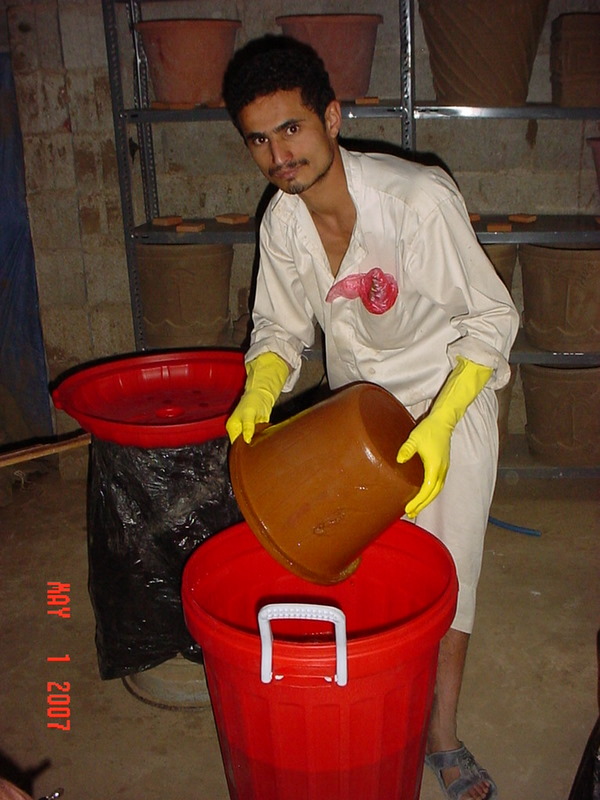
American In Yemen Seeks Success With Water Filters

Sound Byte from National Public Radio USA

by Peter Kenyon

Link to NPR site:  http://www.npr.org/templates/story/story.php?storyId=124012949

An American in Yemen has become one of the few global manufacturers of affordable and deceptively simple ceramic water filters that could play a vital role in bringing safe drinking water to millions of people. Using technology that originated in Latin America, he sold 20,000 filters last year at $25 apiece, and hopes to expand his operations this year.

Direct link to MP3 Audio file:

http://potterswithoutborders.com/wp-content/uploads/2010/02/20100223_atc_18.mp3

Silver Filters: Providing Clean Water to All

From Yemen Today Magazine: http://www.yemen-today.com/go/development/3376.html

31/12/2009 06:48:00 by : Sammi Aryani

Khadija al-Zafeni walks two kilometers to collect water from a rain-fed cistern three times a day. “My children were constantly sick because of the water.

Khadija al-Zafeni walks two kilometers to collect water from a rain-fed cistern three times a day. “My children were constantly sick because of the water. Each of them was stricken with severe diarrhea every month. It would reach the point to which they would be skinny and frail and sleep all day. For a mother, it’s hard to watch your children suffer like that.” This is the daily condition for the staggering 44 percent of Yemenis who currently live without access to clean drinking water, one of life’s most basic necessities, but also the one most easily taken for granted. However, Khadija is gratefully using the past tense, for, thanks to Richard Boni’s colloidal silver filters, her family has now been granted the right to drink water free of disease. As the Silver Filter Company expands, this could be the reality for the rest of Yemen’s rural and urban poor.

Continue reading “Silver Filters: Providing Clean Water to All”

Yemen: war and water woes

Excerpt from International Committee of the Red Cross (ICRC) website: Full Article

——————————————-

ICRC water engineer Johannes Bruwer is just back from a 14-month assignment in Sa’ada, Yemen. He explains why access to safe water is crucial to Yemenis affected by the conflict and how the ICRC has responded to some of the most urgent needs.

Which part of Yemen is most affected by water shortages?

The entire country is affected by water shortages. Because diesel fuel is in short supply, many water pumps are not operating, and using trucks to transport water is becoming so expensive that safe drinking water could soon be unaffordable for most Yemenis. The price of water more than doubled during the month of August in areas affected by the conflict. In the city of Dahyan, which is probably one of the worst affected areas, the ICRC is trying to ease the situation by providing diesel.


Malahit, Northern Yemen. Community members receive colloidal silver water filters distributed by ICRC.

©ICRC / R. Gallway / V-P-YE-E-00640 / April 2008

A special problem facing Yemen is that its population is scattered throughout the country, which makes it difficult to supply everyone on a regular basis.

Full Article

Yemen Silver Filter Factory Update

Submitted by Richard Boni

This article is an update of activities since April 2007 that have led to commercial production of CWFs under trade name Silver Filters. Much can happen in a year.

In April/May 2007, Burt Cohen of Potters Without Borders visited Yemen and, among other things, taught us how to make Colloidal Silver Impregnated Ceramic Water Filters, a/k/a Silver Filters. This was a tremendous learning experience that put us solidly on the road to the successful production of Silver Filters. During the months immediately following the training, we practiced producing filters while attempting to market the concept to NGOs and other organizations working in health, water resources and community development. We were at the time receiving support from the Gesellschaft fur Technische Zusammenarbeir-Integrated Water Resources Management Project (gtz_IWRM). This support not only enabled the training by Mr. Cohen but also provided an avenue for a Pilot Project to test the effectiveness of Silver Filters in the field, in a Yemeni context. We initiated 2 pilot projects, one with CARE Yemen and the other with the Social Fund for Development, a local organization supported by the donor community and the Yemeni government. For these pilot projects we produced 290 filters for distribution to six rural communities, four of which depend upon surface water for drinking water. We are currently awaiting the official results of the Pilot Projects but initial anecdotes indicate that the users, especially those using surface water only, like the filters. I interviewed one woman who had the filter of one month. “Have you cleaned the filter yet,” I asked. “Three times,” she replied proudly. I asked her how much she would be willing to pay for a filter. “I would whatever price required.” Perhaps a bit emotional and even irrational but telling nevertheless.

During the past year or so, when we had no orders for Silver Filters, the owner of the factory, potter Ali Saleh Salman, was simultaneously excited and frustrated; where were the filter orders? A Yemeni saying, ‘Patience is beautiful’ was my response. In the meantime, we produced clay ovens for the wholesale market and flower pots and planters that were marketed directly to the expatriate community. Our customers for flower pots in 2007 included the German and American Embassies, the Ambassadorial Residences of the British and Royal Netherlands Embassies as well as other diplomats, oil company employees, aid workers and the well-to-do Yemeni elite. Because local pottery is merely heated clay, there is a definite market for improved Garden Ceramics. Our problem is that due to limited capacity at this time we are unable to produce Silver Filters and Garden Ceramics at the same time. Our plan is to establish the Silver Filter business and then expand the site in order to increase our production capacity to meet the high demand for improved pottery. If all goes well, we will build another kiln.

In pursuit of opportunities to market Silver Filters, at the end of February 2008 we signed a contract with the International Committee of the Red Cross (ICRC) to produce 1000 Silver Filters. This was our first sizeable contract for Silver Filters; until then we had produced roughly 400 filters over an 8 month period so producing 1000 filters in 2 months would test our mettle. Because Silver Filters take up a lot of shelf time and space, the first order of business was to build additional shelving. We had room to dry and store about 340 filters and needed room for at least 500 or more. However, shelving is expensive in Yemen and we had to find an inexpensive way to meet our need. Old wooden palettes served the purpose well and we built shelves to hold about 800 filters!

Our first day of pressing produced 31 filters, a bit below our projected target of 40. We had to move employees around in a way that matched production needs with their capabilities and skills. Over the next 2 weeks we continued adjusting and improving until we reached 60 filters a day. Our production team consists of two employees mixing and weighing clay, three on the press and record-keeping and one doing odd chores to facilitate production. Two others are responsible for firing, flow testing, Colloidal Silver application and preparing filters for distribution. In the end, however, the team works together on whatever is required that day. It should be noted that the site is without electricity and all mixing and screening is done by hand, a process that takes considerable time and effort. From our perspective, therefore, pressing 60 filters a day is impressive. After a week or so we began firing.

The kiln is a gas-fired brick kiln designed in 2006 by Bernd Phannkuche, the publisher of New Ceramics and one time kiln designer. It is designed to use sixteen 20kg gas canisters, eight at a time: If pressure is lost during the firing, the kilnsman can switch to the other bank of eight gas tanks. These large canisters, however, are uncommon and hard to refill in Sana’a. Also, the refills are not always complete, i.e. they are often not filled completely. Gas tanks are not weighed and the customer never knows how much gas is in the tank at the time of purchase. Smaller 10kg canisters are ubiquitous in Sana’a and are usually filled to capacity. Our potter Ali Saleh figured out that he can fire the filters as well with the small tanks as with the larger ones and so uses the smaller tanks.

During the first five or six firings, we mapped the filter placement; this enabled us to observe the kiln placement for each filter and match that with the results of the flow tests. Our target firing temperature began at 900C but because filters at the bottom of the kiln were flowing at only 1l/hr and our flow rate target is between 1.5 and 3 liters per hour, we adjusted the target temperature to 940C. This has resulted in a greater number of filters passing the flow test with an average of 1.9 – 2.3 l/hr. It should be noted also that we adjusted our clay-sawdust mix to 8.540kg. – .460kg, from 8.550kg – .450kg, a minor move that nevertheless seems to have improved average flow rates. I haven’t made recent calculations but it seems that the average flow rate has increased slightly over the last month or so. Because it takes at least a day for the kiln to cool, we fire every other day or so.

During the 1.5 months we produced for ICRC, we ended up with about 2000 filters; not bad for a start-up facility. After the ICRC production run, a few of the employees went to their village for a family visit. Over the next week or so we began planning for the expansion of the site. We are currently building a storage room to store finished filters, receptacles, brushes, taps, etc. and we need to replace part of the roof over production site. We recently received a new order from the ICRC for 800 more filters while CARE Yemen has ordered 360 and we continue to seek additional contracts. In the meantime we have been selling Silver Filters to individual customers. Our long time supporter, gtz-IWRM purchased 90 filters and CARE Yemen bought 10. These sales help spread the word about the filters and win converts, if you will. There is considerable interest in Silver Filters largely because Yemen lacks potable water in all geographic areas and across all levels of society. Drinking water can be purchased in nearly every small town, large village or city but this is expensive, especially for the less fortunate, i.e. most of the population.

In June 2008, gtz-IWRM will host a workshop to publicize the results from the Pilot Projects. We hope to invite all organizations involved with water in Yemen as well as private investors, traders, etc. As with all businesses, we hope to expand production and develop distribution channels. Hopefully, in the not too distant future, Silver Filters will become a household name in Yemen.

Ceramics may alleviate Yemen's water crisis


Yemen Observer: http://www.yobserver.com

Posted in:
News Varieties

Written By: Ali Marmaduke

Article Date: Jul 7, 2007 – 12:51:36 AM

ceramics_1.jpg

Yemen’s only high-temperature kiln, built by GTZ to produce ceramic water filters and irrigation pots

These days, political violence makes headlines more frequently than
development issues. America’s war in Iraq, Al Qaeda’s war
against…everyone, and ethnic cleansing in Sudan are hot topics in the
media and among the world’s leaders. But, in Yemen, drinking
water often poses the biggest threat to survival. Every day there are
5,000 deaths worldwide, mainly children under the age of five, due to
diarrhea caused by unsafe water, according to a 2006 World Health
Organization report. Diseases related to inadequate water sanitation
cause an estimated 80 percent of all sickness in the developing world.

In Yemen, only 21.5 percent of the rural population has access to safe
drinking water and only 19 percent have adequate water sanitation
facilities, according to a 2006 GTZ (German Technological Cooperation)
study. Infant and child mortality rates are 71 deaths per 1000
live births and 105 deaths per 1000 live births, respectively. Those
rates are higher in rural areas. The U.N.’s Millennium Development Goal
is to halve the number of people unable to reach or afford safe
drinking water by the year 2015. But achieving that goal would require
that at least 125,000 people be provided access to safe water supplies
each day before the 2015 target. The shortfall in the
availability of drinking and irrigation water in Yemen is primarily due
to overpopulation.

And the fact that an estimated 70 percent of the country’s water supply
is used irrigate Qat fields exacerbates the crisis. Although the Yemeni
government has still not implemented adequate measures to correct this
situation, international humanitarian organizations are working with
the Yemeni National Water Resource Authority to provide rural and urban
populations with the means to sanitize drinking water and to more
efficiently irrigate crops to conserve the country’s dwindling water
supply. According to the NWRA website, “The water situation
[in Yemen] is becoming progressively worse because of population growth
and increasing water demand.

The government is fully aware of the challenge this poses to the
country; therefore, it has given a very high priority to water
security.” The German government has been one of the main donors to the
improvement efforts of Yemen’s water sector. Other donors include the
World Bank and the Dutch government. The 21.5 percent of Yemen’s rural
population that has access to safe drinking water gained that access in
the last two decades, according to the GTZ website. In 2006, the
international NGO, Integrated Water Resource Management sent a team to
Yemen to work to determine what would be required to introduce two
low-tech products that would alleviate Yemen’s water crisis.

The first product was an unglazed indigenous clay pot (called ‘jarar’
in Arabic) that is buried neck deep underground and periodically filled
with water. When full, the pot saturates the surrounding soil with
water that is sucked through the porous clay when the ground is dry and
delivers water directly to the plant root zone. The water remains
inside the pot when the soil has reached its moisture capacity.
This method helps reduce the amount of water required for agriculture
by up to 70 percent. It also increases farmer incomes by
improving plant survival, increasing plant yields by up to 70 percent,
and increasing fruit and vegetable size.

However, the traditional clay pots produced in Yemen quickly
disintegrate and break with prolonged exposure to water because they
are not fired at temperatures high enough to alter the molecular
structure of the clay into durable ceramic. The second product that the
IWRM team is currently introducing to the Yemeni market is a water
filtration device that was developed in Guatemala in 1981 by the
Central American Industrial Research Institute and promoted by Potters
for Peace, a member of the World Health Organization’s International
Network to Promote Household Water Treatment and Safe Storage.
The device was created to be a low cost filter that could be fabricated
at the community level and provide potable water to the poorest of the
poor.

ceramics2_1.jpg

A diagram and photo of a silver filter, and the press used to mold them uniformly

It is called a Colloidal Silver Impregnated Ceramic Water Filter. “I call them ‘silver filters’ for short, because I can’t come up with a better name,” said Rich Boni, an American independent contractor working with GTZ. Boni has lived in Yemen for nearly 11 years and he is well acquainted with Yemen’s water crisis. “One silver filter can provide a day’s worth of drinking water for a family
of six,” Boni said. “I know that kind of flies in the face of
reality here in Yemen because the average size of a Yemeni family is eight, but this is the largest size we make right now.”

The silver filters are 10” deep and 11” wide buckets that resemble
flower pots. They are made from local clay. After being
fired in a kiln, the buckets are impregnated with a liquid colloidal
silver solution that acts as a bactericide. The bucket is placed inside
a receptacle, made of plastic or clay, and is filled with water.
That water filters through the bucket at a rate of 2-2.5 liters per
hour and rests in the receptacle until poured through a spigot and
consumed. “The flow rate of the filters has been tested
over and over to make sure that water remains within the ceramic long
enough to kill all the bacteria, but short enough to be convenient,”
Boni said. Clinical test results in 11 countries have shown that silver
filters to eliminate 99.88 percent of water born disease agents.

Institutions like the Massachusetts Institute of Technology and
USAID have participated in the testing of silver filters and have
officially confirmed their efficacy. Silver filters can be sold
for YR 2,200, require brief cleaning with a hard brush once a month,
last for up to two years, and can be produced by local potters using
local materials. However, GTZ’s and IWRM’s two-part solution to Yemen’s
water crisis had two requisites. The first requirement was
potters. Yemen has a tradition of clay production and plenty of
potters who use a traditional method of clay pot production. But it
quickly became evident that the crude gas-fired kilns used by these
potters were unsafe (two months ago a kiln exploded in Dhamar, killing
a child) and incapable of firing clay at a high enough temperature to
create ceramic pottery (traditional kilns only reach about 500 degrees
Celcius).

So the second requirement was an environmentally friendly gas-fired
kiln that was safe, could fire at high temperatures (up to 900 degrees
Celcius) and could be built entirely of local materials. German Dr.
Michael Klinger was a part of the IWRM team in charge of introducing
and promoting water conservation technology in Yemen. He
suggested that if the German government was going to fund the
GTZ-directed construction of a high temperature kiln for the production
of irrigation jarar, it would be prudent to begin producing silver
filters, which also require firing at high temperature.

His advice did not fall on deaf ears. About a year later, at
the Modern Pottery Workship, just outside of Sana’a on Wadi Dhahr Road,
the 120 cubic feet, propane-fueled high-temperature kiln was built and
a press was constructed, with the supervision of a representative of
Potters for Peace, to produce uniformly molded clay buckets for silver
filters. But, currently, there is only one high-heat kiln
and only one family of potters in the entire Republic of Yemen to
produce these ceramic products. Ali Saleh Sa’ad, 35, is
originally from al-Raima. His father was a potter.

His grandfather was a potter. His family has been potters
“since the time of the Prophet Mohammad,” he said, grinning
proudly. GTZ, Rich Boni, and Dr. Klingler of the IWRM team
formed a relationship with Sa’ad about a year ago. The Sa’ad
family owns and lives at the Modern Pottery Workshop and includes, Ali,
his wife, parents, brother, and his two cousins. The workshop is
constructed of corrugated sheet metal supported by wood beams and a
cinderblock foundation. Ali and his family went into debt to buy
the land and to contribute to the construction of the kiln.

Ali has been repaying that debt by making tannoors (small traditional
Yemeni clay ovens) for his debtors to sell. Each tannoor oven
sells for around YR 600, but GTZ and Rich Boni are hoping the Yemeni
market will be receptive to the jarars and silver filters that the
Modern Pottery Workshop is producing so Ali can focus on their
production and can make a more significant income. “I really want to be
associated with this project because I think it could change a lot of
people’s lives all over this country,” said Boni. “And I think
this is going to spread because we’re not working as a huge
bureaucratic organization that takes forever to do the smallest
things.

We just need to find an NGO that will go around the country and educate
people about how to uses these filters and how to clean them once a
month.” There has been some interest in the silver filters and jarars
around Yemen. Before the Modern Pottery Workshop began production
this year, 500 silver filters were imported from a Potters for Peace
workshop in Cambodia to the Shabwa Province with very good acceptance
among the recipients.

Sana'a Test Firing Curve 7:42am – 7:40pm

Cones 010 mini-919 C.
Standard Cones
#013-837-859
#012-858-880
#011-873-892C
#09-917-928C

Firing start time 7:42AM

Firing end time 7:40 PM

TIME LOWER DOOR TOP DOOR CHIMNEY NOTES
0
0.5 60 85 122 4 Burners
1 69 93 128 1.3hr-6 Burners
1.5 93 118 156 Damper@ 15cm
2.08 111 133 170
3.1 173 195 248
3.58 187 209 260
3.95 208 230 307
4.53 293 295 388
5 345 317 415
5.28 347 401 448
5.45 417 401 448
5.45 417 401 452
5.75 438 480 465
6.68 414 518 481
6.88 504 536 501
7 509 537 509
7.33 539 575 530
7.53 554 588 543
8 610 646 602
8.35 650 684 639
8.66 675 708 684
9 712 744 717
9.2 729 763 738
9.58 750 729 755
9.75 784 813 784
9.96 748 830 804
10.16 832 862 836
10.2 844 874 845
10.26 848 877 855
10.45 865 891 867
10.5 871 897 874
10.58 874 899 878
10.66 877 901 881
10.86 880 903 885
11 883 906 888
11.1 885 906 890
11.43 880 902 886

Photos From Yemen GTZ- Integrated Water Resources Management (IWRM) Project

I just received these photos from Burt…

ali-salman-and-burt-cohen-mixing-test-batches-for-cwf.JPG ali-salman-and-burt-cohen-mixing-test-batches-for-cwf

hayel-said-saleh-making-a-tanoor-overn.JPG hayel-said-saleh-making-a-tanoor-overn

front-of-press.JPG front-of-press

back-of-double-scissor-press.JPGback-of-double-scissor-press

new-filters.JPGnew-filters

dsc01956.JPGFilters in the kiln

dsc01995.JPGFlow Testing Filters

ali-applying-cs.JPGali-applying-cs

Final Report and Recommendations for development of the Silver filter workshop – Yemen

GTZ-Integrated Water Resources Management, (IWRM) is involved in projects concerned with water management in Yemen. This project’s involvement with traditional Yemeni potters began to encourage the production of irrigation pots as a tool to reduce the amount of water used in farming in water poor Yemen. At the same time there was interest in the introduction of Ceramic Water Filters. (CWF) 500 water filters had been imported into the southern Shabwa Province with very good acceptance amongst the recipients. (These 500 filters were produced at workshops originally set up by Potters For Peace for IDE Cambodia.) It was felt that a combination of CWF, irrigation pots, with traditional and non-traditional pottery could diversify and strengthen the income of a potter family of potters willing to enter into a relationship with GTZ was identified before my arrival.

The Salman pottery workshop in Sana’a Yemen is located in a rural area of the city. This workshop entered into a relationship with GTZ earlier this year. Mr. Richard Boni working for GTZ has coordinated this relationship along with Mr. Michael Klingler of GTZ Integrated Water Resources Management. The Salman family lives at the workshop and includes Ali Saleh Said Salman, Ali’s father-Saleh Said Salman, Ali’s brother- Muntesar Saleh Said Salman, cousin Tewfik Ali Yahya Azizzi, Selam Sale Said Salman Ali’s mother- Fatimah Ali Mahdi and Ali’s wife.

Some months before my arrival, a catenary arched downdraft kiln approximately 120 cubic feet in size (4 cubic meters) was designed and built for the workshop by Bernd Pfannkuchen through assistance by GTZ-(IWRM Yemen . The kiln is propane fired, which was considered the fuel of choice, because of the high cost of wood and charcoal. The size of the kiln reflects the need to accommodate tanoors, traditional Arab ovens, which are a substantial part of the production of the workshop. These ovens are made in a number of different sizes, the largest of which can be almost one meter in height and 50cm in diameter. When I worked in the pottery, the potters were in the midst of filling an order of tanoors as a partial repayment of loans advanced for the construction of the kiln and the purchase of the land.

The construction of the pottery workshop and compound is cement blocks with corrugated sheet metal roofing. When I arrived in early April the kiln had only been fired a few times.

The main production at the workshop is traditional Yemeni unglazed earthenware pots. The clay is mostly unrefined and prepared quickly by wetting the clay and foot wedging on the floor of the workshop. The pottery produces ware by coil and smear method, forming on plywood batts, which are set on platforms, usually old car tire rims. The potters form by walking around the developing forms (usually backward) while manipulating the clay in a series of deft processes akin to using a potter’s wheel: coiling and smearing until the basic form is begun, then paddling with a wooden form, drawing and evening the walls of the pot- next the form is thinned and drawn up and finally smoothing with a wet cloth. These potters are masters of this method of forming. They work as a family unit, father and sons sharing in all of the work. .

The production of ceramic water filters required changes throughout the workshop beginning from the clay preparation. Traditionally, clay is trucked in from the mine and deposited in an area adjacent to the workshop and left uncovered and open to the elements.

Normally clay for CWF must be dried and screened and put in sacks or otherwise covered to reduce variation caused by moisture. In Sana’a the dryness of the desert doesn’t seem to be much of a problem. Even on days when it rained, most of the moisture in the clay had evaporated within a couple of hours. Despite this, I feel it is important that the clay be carefully screened and sacked. Clay for traditional ware is not screened. The potters understand that the filters require screened clay but they may not yet see that this also affects the characteristics of the finished ware. Clay that is finer due to screening will form pots which are denser and therefore have less thermal shock qualities. For most pieces this doesn’t cause a problem but it may for tanoors. Not being familiar with the day to day use of a tanoor oven used in a traditional Yemeni kitchen, I do not know to what extent this will be a problem.

Before my arrival in Yemen instructions were sent to the pottery to prepare 50 sacks of screened clay and a large quantity of dried sawdust. A large cement block soaking tank was made for the flow testing of filters and colloidal silver was purchased for the treatment of fired filters. A log of activities was prepared as work progressed.

Upon my arrival in Yemen, Richard Boni and I spent more than a week modifying an existing mechanical press for forming ceramic filters from clay. After the press was prepared, the moulds were attached, and it was delivered to the pottery. The inability to find a clay mixer of an appropriate design meant that it was necessary to prepare the clay/sawdust mix by hand using plastic mixing buckets.

The screened dry clay and sawdust were first weighed using a gram scale and then dry mixed. The blended dry materials were then wet mixed, lightly wedged, and weighed again into 9kg batches.

Each of the filters was formed using the new press. The female mould was lined with a plastic bag and the male mould was also covered with a bag. These plastic bags act as separators and allow the filters to be released cleanly from the moulds. The 9 kg. Charge of the clay/sawdust mix was pressed into the bottom of the female mould and it was raised into position. A hydraulic jack was set into position on the press and the female mould was pressed up with20 tons of pressure. The top of the press frame is hammered with a rubber mallet to release the filters. Once the pressure was released, the female mould was lowered and the plastic liner was removed from the female mould. Next the inside of the now accessible new filter was fettled to smooth and correct any imperfections. The filter in the female mould is now raised again on the press and an ejector rod is placed into position and the new filter is ejected from the female mould by lowering it on the press. Finally the new filter is removed from the press. Each filter was carefully dried by loosening the remaining plastic bag from against the outside of the newly formed filter. The filters were carefully monitored to prevent them from drying too quickly in the arid desert air by keeping them loosely covered with plastic and then after uncovering them, by turning them upside down if the lips dry too quickly. Drying took 4 to 5 days.

Once dry, the filters were stacked in the kiln and fired to a target temperature of 900C. Information concerning firing can be found in the two excel documents-‘Sana’a Test Firing Curve’ and ‘April 28th 07 filter firing- Sana a’

Six different clay/sawdust ratios of filters were attempted. The formulations were dried and fired in the kiln. The results of this series of filter tests showed that the following mix produced the best flow rate results:

Mix #1

Formula Batch Wt.

Sana’a Clay- 95% 8550

Sawdust 5% 450

Total 100% 9000gr.

2.4liters of water

See word document – ‘Yemen Ceramic Water Filter Flow Test Results’

The average rate of water flow for this proportion was 2.33liters per hour. It must be remembered however that this flow rate was achieved at a temperature of between 915-923 degrees Celsius. If the temperature is lowered substantially from this, the proportion of sawdust to clay will need to be adjusted. I think that a target of 900 C. probably will not require adjustment however flow testing will determine this.

One Hour Flow test-After forming and firing to a temperature of between 912-923C most filters were soaked in water in the cement tank for more than twenty four hours. The filters were then filled with water and allowed to stand for one hour. The amount of water filtered was measured using a PVC tee shaped gauge. (See photos) The cement soaking tank needs to be kept full of water for a period of time and then rinsed out to clean out the fine silt which will become trapped in the pores of the new filters.

I would recommend that another batch series of filters be formed and tested. This will further refine the flow rates. A minimum of ten filters of Test A, B and C below should be fired and flow tested. Once this test is finalized and the final clay/sawdust proportion is decided upon, the workshop can translate the weight proportions to volume measurements with appropriate sized containers. This should considerably speed up the forming process.

Test A Formula Batch Wt.

Sana’a Clay- 96% 8640

Sawdust 4% 360

Total 100% 9000gr.

2.4liters of water

Test B Formula Batch Wt.

Sana’a Clay- 96.5 8685

Sawdust 3.5% 315

Total 100% 9000gr.

2.4liters of water

Test C Formula Batch Wt.

Sana’a Clay- 97% 8730

Sawdust 3% 270

Total 100% 9000gr.

2.4liters of water

Colloidal Silver Recommendations and Precautions

We conducted a training session on the application of Colloidal Silver (CS) Out of this session I have made a number of recommendations for the workshop

  • A room with shelves should be built for the storage of CS and dipping solution and utensils
  • Containers and Mixing implements should not be used for other purposes
  • CS should be kept in it s original container
  • When not in use CS dipping solution should be kept in a covered container
  • Mixing and application of CS must be done with protective gloves to limit skin contact
  • Clean up of containers and implements will result in contaminated cloth and water, this material should be disposed of in the latrine
  • Two persons should be designated for CS preparation and application
  • The next time that CS is applied to filters the methodology should be reviewed again especially the need to mix the solution properly before dipping
  • CS in the concentrated form used for application to filters can accumulate in the body , care must be taken to prevent contamination of the workshop environment, ground etc. These precautions should be reviewed the next time CS is applied to filters. These precautions should be provided in Arabic

Safety recommendations for the handling of propane

Propane is a not new in Yemen being produced there, but as a fuel for artisan potters it is. The sophistication of the firing system at the Salman workshop is well thought out. Of particular importance is the forethought of including small safety shut off valves on each burner. A problem of the gas system is that the removal and filling of the 16 gas cylinders requires careful monitoring to be certain that there are no leaks at the cylinder valve as well as at the hose clamps.

In a situation like this, where a number of small gas cylinders are teamed together to a manifold, the cylinders cannot be completely discharged because of the speed of gas withdrawal during the firing. The potters are understandably unhappy by the amount of gas remaining that they lose due to this. They have made attempts to withdraw this remaining gas from one cylinder to another. This is not a safe practice and they must be cautioned about this.

For a number of months before my arrival in Yemen attempts were made to locate both a hammer mill for crushing clay and a mixer for preparing the wet clay batches without success. An appropriate mixer design was shared with Nasser machine shop for quotation.

  • An appropriate clay mixer design may be found in the Adobe Acrobat 7.0 Document – clay mixer
  • Filters should be individually numbered tracking number while they are still in the mould This tracking number allows the workshop to better understand the success of the production process and it also allows for the systematic monitoring of the filters in the community. It is essential that the workshop record the sale of filters so that they may be followed. Filters formed for the test series were numbered by using iron oxide. A rubber stamp for numbering filters has been ordered for the workshop.
  • A health monitoring agency must still be identified for the field assessment of filters as soon as filters are ready to be sold. Potters Without Borders requests that GTZ inform us when this relationship is established so that we may assist with questions that may arise from the monitoring process
  • Presence/absence tests (P/A test) from Hach Company of Colorado were identified for the monitoring of filter’s ability to remove bacteria. The use of P/A tests were discussed and Richard Boni conducted the first test of water from a contaminated source to demonstrate the filters ability to eliminate bacteria

Conclusions after set up of the filter workshopThe conclusion of the ceramic water filter training now means that the Salman pottery workshop has the ability to form filters from locally available raw clays. The ability of the workshop to take this new capacity and deliver properly functioning ceramic water filters into the community will require careful follow.The Salman workshop will need support in order to be able to consistently reproduce filters with correct rates of flow. The Salman`s have a strong understanding of ceramic process. As an example within two weeks of first using the new ceramic filter press, the workshop adapted the forming process to simplify and speed up the forming of irrigation pots. Although I discussed the need for consistency in processing of raw materials and in the forming process I feel the workshop will need assistance to maintain this discipline and to make sure that all those being trained in the key processes of, material preparation, forming, firing, flow testing, and colloidal silver application are well prepared as well. Richard Boni has been instrumental in the members of the Salman workshop understanding and accepting these new technologies. His continued involvement in monitoring and assisting the workshop with scientific method is invaluable to the workshops success.A number of extensive studies on similar new ceramic water filter workshops indicate that the production of silver filters in Yemen will result positively impact the health of the end users. Water poor Yemen currently does not have the ability to service outlying communities with piped potable water. CWF is a credible technology that will deliver safe water to at risk communities with little waste. Potable water is produced directly in the homes of users without the need for separate extensive piped systems.

After the successful firing of filters, Richard and I went into the commercial areas of Sana’a and were able to find a plastic receptacle which fit the filters. Since then a second filter has been identified. The Salman workshop is also developing a receptacle made out of clay similar in design to traditional Yemeni water containers. Developing a number of receptacles at various prices will encourage the acceptance of CWF. GTZ has arranged for the translation of the cleaning protocols for the filters. Other CWF workshops have contracted plastic receptacles with both instructions and logo imprinted directly in the body of the plastic in so doing they create professional approach to the marketplace and speed up acceptance.

  • Production Forms for water filters-to follow
  • A computer assisted design(CAD) for a mechanical screen to prepare sawdust will follow

Download Document 49kb: burt-cohen-potters-without-borders-yemen-final-report-a.doc

GTZ Yemen Ceramic Water Filter Flow Test Results

GTZ Yemen Ceramic Water Filter Flow Test Results

Summary

6 -#1 Mix Filters 2.33 liters/hour average

10 – #2 Mix filters all more then 3.5 liters per hour

9- # 3 Mix Filters- All more then 3.5 liters/hour

1-#4 Mix Filter- More then 3.5 liters per hour

No # 5 Mix filters survived the forming process –due to fragility

4 -#6filters- All more then 3.5 liters/hour

Total Filters Flow Tested-30

Filters formed- 48

One Hour Flow test-After forming and firing to a temperature of between 912-923C most filters were soaked in water for more than twenty four hours. The filters were then filled with water and allowed to stand for one hour. The amount of water filtered was measured using a pvc tee shaped gauge which was set on the filters. (See photos)

Mix #1

Formula Batch Wt.

Sana’a Clay- 95% 8550

Sawdust 5% 450

100% 9000gr.

Of 6- Mix #1 Filters

2.5liters

2.5 liters

2.5 liters

2 liters

2 liters

2.5 liters

Flow Test-2.33 liters/hour average

Mix 2– 5% More clay then 50/50 Proportion

Formula Batch Wt.

Sana’a Clay- 90% 8100

Sawdust 10 900

100% 9000gr.

Flow test

Of 10- Mix#2 filters- All filters were more then 3.5 liters per hour

Mix 3– 50/50 Proportion by Volume

Formula Batch Wt.

Sana’a Clay- 85.6% 8127

Sawdust 14.4 1372

100% 9499gr.

3.5 liters water (estimated)

Flow test–

Of 9- Mix #3 Filters- All filters were more than 3.5 liters/hour

Mix 4 – 5% Less clay then 50/50 Proportion

Formula Batch Wt.

Sana’a Clay- 80% 7136

Sawdust 20% 1784

  1. 8920

Flow Test

Only 1- Mix# 4 filter emerged from the mold intact, because of fragility-( One filter broke during flow testing) This filter was more than 3.5 liter/hour

Mix #5

Formula Batch Wt.

Sana’a Clay- 75% 6750

Sawdust 25% 2250

100% 9000gr

Flow Test-

No Mix#5 filters survived the forming process

Mix #6

Formula Batch Wt.

Sana’a Clay- 92.5% 8325

Sawdust 7.5% 675

100% 9000gr.

Flow test

Of 4 –Mix# 6 filters-all were more than 3.5 liters/hour

Download full document 34kb: yemen-ceramic-water-filter-flow-test-results.docyemen-ceramic-water-filter-flow-test-results.doc

April 28th 2007 filter firing Yemen GTZ

Time Description Door Bottom Door Top Chimney Side


Kiln On 4 corner burners


:30
60 93 122


1:00 Damper at 10 cm 69 93 128


1:22 6 burners (2 more near to the door)


1:30 Damper @ 15 cm 93 118 156


2:05
111 133 170


3:06
173 195 248


3:35 Smoke beginning to generate from filters 187 209 265


3:40 Heavy smoke


3:57
208 230 307


4:23 smoke reduced 228 245 337


4:26 8 Burners Damper@ 24 cm


4:38 Damper @ 27 cm 293 295 388


5:00 10 Burners 345 317 415


5:17
347 401 448


5:22 12 Burners (2 on low)


5:27
417 401 457


5:45
438 480 465


6:41 All burners on low 474 518 481


6:53
504 536 501


7:00 Increase two burners either side of the door 509 537 509


7:20
539 575 530


7:32 Increase ten more burners 554 588 543


8:00 Increase ten burners again slightly more 610 646 602


8:22 Damper @ 24 cm 650 684 639


8:40 Increase 8 burners on chimney side to full on 675 708 684


9:00 Increase 4 burners on door side to full 712 744 717


9:12 All burners on full 729 763 738


9:35
750 779 755


9:45 Increased pressure on gas manifold by kiln 784 813 784


9:58 Switched propane cylinder bank to +pressure 798 830 804


10:05 Cone 013 down 012 bending


10:10 Cone011 Bending 832 862 836


10:12 Cone 011 @ 3 o clock


10:14 Cone 011 down 844 874 845


10:16 Open damper to 22 cm 848 877


10:27
865 891 867


10:30
871 897 874


10:35 Begin Soaking period 874 899 878


10:40 All Cones except 09 down -reduce pressure 877 901 881


10:52 increase pressure slightly to maintain pressure 880 903 885


upper Cone 09 @ 3 o clock


11:00 ` 883 906 888


11:06
885 906 890


11:26
880 902 886


11:39 Kiln Off


Notes on the Sana’a, Yemen filter firing April 28th, 2007
The firing of the ceramic filters followed a firing of tanoor ovens by two days insuring that the kiln was well dried.
In firing the filters I was particularly concerned that all of the sawdust would be completely burned out so that trapped carbon would not cause a problem with the filters. This is necessary so that the finished filter be as strong as possible and so that flow rates not be effected by carbon in the filter body. Care must be taken in the stacking of the filters in the kiln to separate the filters using spacers so that heat can infiltrate throughout the setting. Filters should not stacked bottom to bottom without spacers as well. The filters staked on the floor of the kiln should be stacked on top of brick to elevate them. Another thermocouple was installed near the floor of the door to monitor the difference in temperature between the floor and the upper part of the kiln. It is recommended that monitoring of the temperature advance is done with a combination pyrometer, Orton temperature cones and draw trials.

A warm up period with a target temperature of 300 Celsius in the first 4 hours proved adequate to insure both moisture and carbon was not trapped.
After the warm up, an advance of 100 C per hour was desired up until a target temperature of 900 C. In practice we took longer to advance in temperature due to the amount of smoke which was generated by the burning out of the sawdust . At target temperature the firing was soaked for one hour. I had intended to soak for a longer period as per advice by other filter technicians, but after discussion with Bernd Pfannkuchen the kiln designer, and through evaluation of the draw trials* at the target temperature I decided that one hour soaking was adequate. An examination of the finished filters showed that there was no trapped carbon. The original recommendation of a longer soaking period is based on the use of the Mani kiln which is using solid fuels (wood) whereas the Sana’a catenary kiln fires with Propane under oxidizing conditions. Having the designer of the kiln to assist in the filter firing was a real advantage. Bernd gave advice and the kiln design proved very versatile. It is noteworthy that the Orton cones and the pyrometers showed less then one cone differential in temperature throughout the kiln.
*The draw trials were made from the same mix of clay and sawdust and formed into rings. These trials were positioned in the kiln on two levels near the floor and withdrawn through the ports in the door. These rings were then examined for residual carbon as well as for strength.